
About Alexandra Bowers
Alexandra Bowers is a Phoenix-based artist who received her BFA in 2012 from Arizona State University. Inspired by the natural environment, Bowers utilizes imagery collected while exploring to produce wood-burned and mixed-media studies of plants and animals. Bowers has had the privilege of showcasing her work extensively in Arizona, and across the country, most notably at the Peabody Essex Museum in Salem, Massachusetts. Bowers’ work has been showcased in Phoenix Sky Harbor International Airport’s Museum Gallery and was subsequently acquired for its permanent art collection. She was one of three chosen for the first “Summer Artist Residence Program: Biomimicry Challenge” at the Tempe Center for the Arts. In 2020 her work was selected for the Tempe Municipal Court as part of the Tempe Public Arts program. It has since been purchased to stay in the Tempe Portable Works permanent art collection. In 2021 Bowers was chosen by the Mesa Contemporary Arts Museum to debut her solo installation “A Murmuration of Found Feathers in Flight.” Bowers asked the community to send her photos of found feathers, which she used to recreate over 800 mixed-media pieces for the installation. She was recently chosen by the Biomedical Institute of Phoenix and Bentley Gallery to collaborate with a heart specialist from the University of Arizona as part of the first “Artist and Researcher” cohort. In the Spring of 2025 Bowers opened her solo exhibition “Plant Medicine: An Altar by Alexandra Bowers” at Lapis Room in Old Town Albuquerque, New Mexico. As Bowers remains on her journey as an artist, she continuously seeks opportunities to enrich the arts nationally and internationally.
Artist Statement
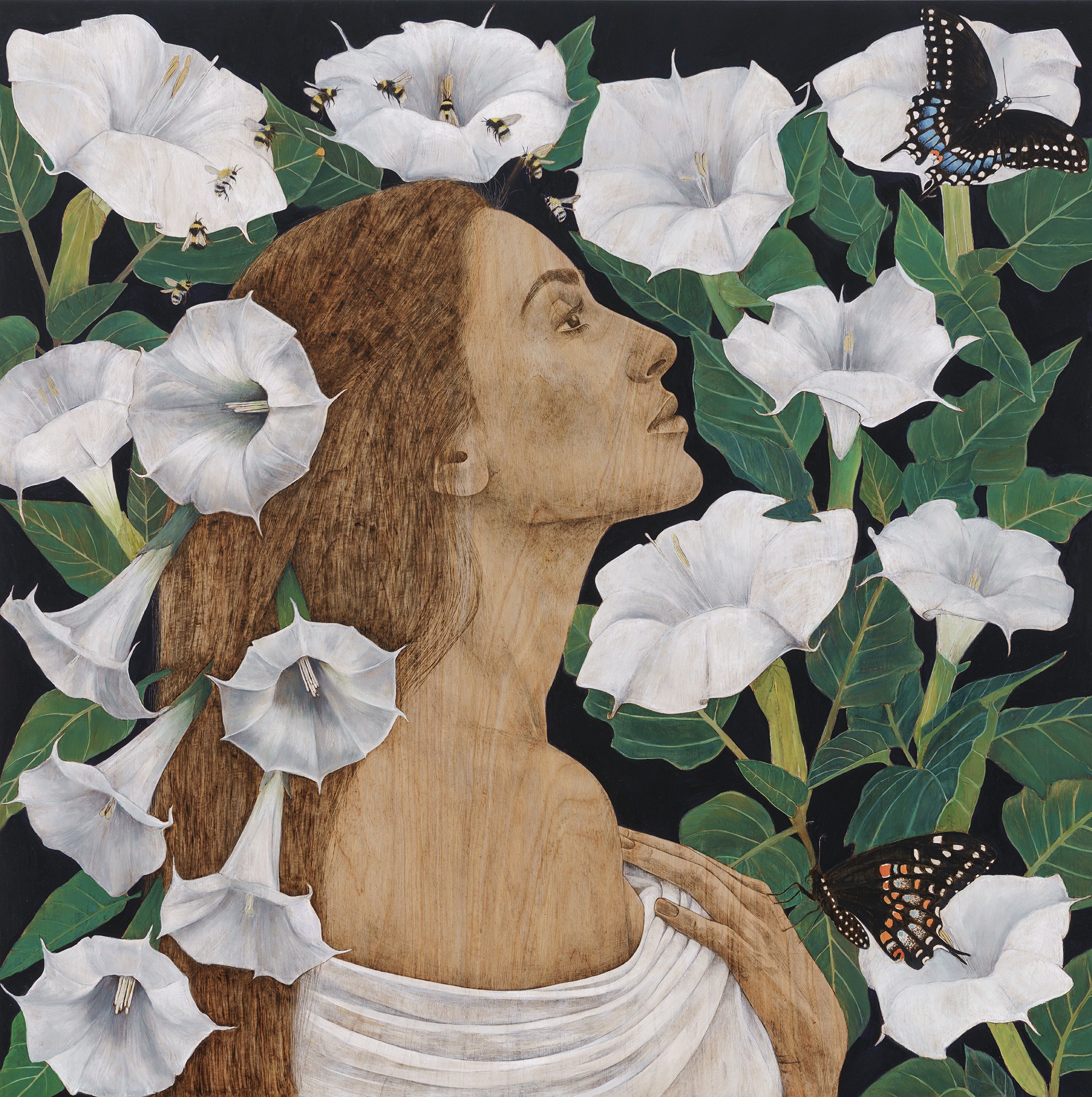
Rooted in the Sonoran Desert, my practice reflects on the sacred relationship between humanity and the natural world at a time of profound ecological and societal change. Through pyrography and water-soluble wax pigment, I depict native species as contemporary icons—symbols of endurance, transformation, and vulnerability. Drawing from desert ecologies and the visual language of devotional imagery, my work responds to a growing cultural and environmental disconnection, where both attention and landscape are increasingly fragmented. Each piece becomes a gesture of preservation and reverence, elevating the natural world as something worthy of veneration before it is lost. By merging observation with metaphor, I ask viewers to look closely, to remember, and to recognize the divine that persists within the living landscape. For me, this work is an act of devotion—a way to remain in conversation with the land that continues to shape who I am.